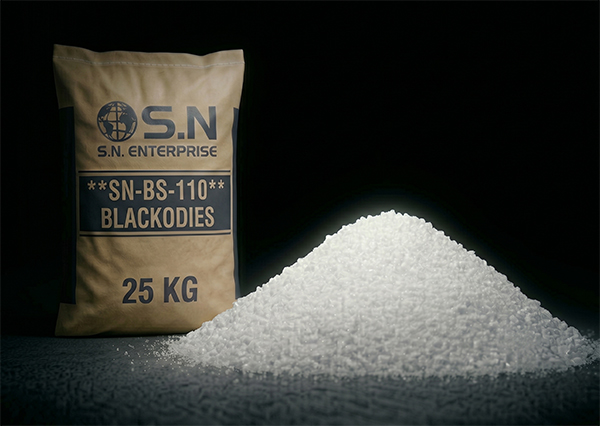
Blackening Salt

Blackodies SN BS-110

An alkaline hot-immersion blackening salt that converts the surface of iron and steel into deep black iron oxide (Fe₃O₄). Uniform finish at 140–150°C, near-zero dimensional change, and improved corrosion resistance when sealed with oil.

Blackodies SN BS-110 — Alkaline blackening salt, 25 kg HDPE bag
Working Temp
140°C – 150°C
Process Time
10 – 15 minutes
Coating Type
Black oxide (Fe₃O₄)
Documentation
COA · MSDS · TDS

Product Overview

Blackodies SN BS-110 is an alkaline salt compound designed for the hot-immersion black oxide process on iron and steel. When dissolved in water and heated to its working temperature of 140–150°C, the bath reacts chemically with the iron on the component surface, converting it into a stable layer of black iron oxide — magnetite (Fe₃O₄) — without the need for electroplating equipment or organic coatings.

Because the coating is a true chemical conversion of the base metal — not a deposited layer — it adds virtually no measurable dimension to the component. This makes Blackodies SN BS-110 the preferred choice for precision parts, threaded fasteners, cutting tools, and any component where tight dimensional tolerances must be maintained after surface finishing.

On polished or reflective surfaces, the process produces a jet black, lustrous finish. On pickled or matte surfaces, it delivers a uniform dull black. In both cases, a post-treatment application of rust preventive oil is required to activate the coating's corrosion protection — the black oxide layer on its own is porous and provides minimal barrier protection without the oil seal.

Technical Specifications

Product CodeBlackodies SN BS-110
Process TypeHot alkaline immersion blackening
Coating FormedBlack iron oxide — magnetite (Fe₃O₄)
SubstrateIron and steel (carbon steel, alloy steel, cast iron)
Working Temperature140°C – 150°C
Process Duration10 – 15 minutes immersion
Pre-dip5 minutes in separate pre-dip bath
Coating Thickness~1 – 2 microns (near-zero dimensional change)
Finish on Polished PartsJet black, glossy
Finish on Pickled PartsUniform dull black
Post-TreatmentRust preventive oil or wax sealer (mandatory)
Packaging25 kg HDPE sealed bags
StorageCool, dry place — keep sealed, avoid moisture
DocumentationCOA, MSDS, TDS included with every order

What the Black Oxide Process Delivers

Deep, Uniform Black Finish

Produces a consistent black oxide coating across every surface — recesses, threads, internal features — that electroplating and spray coatings often miss or build unevenly.

Near-Zero Dimensional Change

At 1–2 microns, the coating adds no meaningful dimension to the part. Threads remain within tolerance, fits stay correct, and precision ground surfaces need no rework after treatment.

Corrosion Resistance (Oiled)

Once sealed with rust preventive oil or wax, the black oxide layer provides a barrier that resists atmospheric moisture and mild corrosive environments — extending part storage and service life.

Low Light Reflectivity

The matte-to-gloss black surface reduces reflective glare — a requirement for optical instruments, defence hardware, camera components, and any precision assembly where surface reflection is undesirable.

Cost-Effective vs. Plating

Hot alkaline blackening requires no plating bath, no rectifier power supply, and no precious metal anodes. Operating cost per batch is significantly lower than zinc, nickel, or chrome electroplating.

Simple Bath Maintenance

Maintain the boiling point between 140–150°C — add salt concentrate if temperature drops below 140°C, add water if it rises above 150°C. Replenish salts gradually as loads are processed.

Full Blackening Process — Step by Step

A consistent black oxide finish depends as much on surface preparation as on the blackening bath itself. Every step below is necessary — skipping pre-treatment or post-treatment will result in patchy coating, early rust, or poor adhesion.

1

Degrease

Remove all machining oils, coolants, fingerprints, and contamination using an alkaline degreaser or solvent cleaner. The surface must be completely free of organic contamination before blackening.

2

Rinse

Rinse thoroughly in clean water to remove all degreaser residue. Carry-over contamination into the blackening bath will cause spotting and uneven coating.

3

Acid Pickle (if needed)

For rusted or scaled components, pickle in a dilute acid solution to remove oxide scale and expose bare metal. Rinse again immediately after pickling.

4

Pre-dip

Immerse components in the pre-dip blackening bath for 5 minutes. This begins the surface activation and ensures the main blackening bath produces an even coat.

5

Blacken

Transfer to the main Blackodies SN BS-110 bath at 140–150°C. Immerse for 10–15 minutes. Agitate gently if needed for complex geometries.

6

Hot Water Rinse

Rinse immediately in hot water to flush off all residual salts. Salt residue left on the surface will cause white crystalline deposits and accelerate corrosion.

7

Dry

Air dry or oven dry thoroughly. Any residual moisture beneath the oil sealer will cause rust to develop from below the black oxide layer.

8

Oil / Seal

Apply rust preventive oil by dipping, brushing, or spraying. This step is mandatory — the black oxide layer is porous and provides no useful corrosion protection without the oil seal.

Bath Temperature Control

Bath Reading Corrective Action
Below 140°C Add more BS-110 salt concentrate
140°C – 150°C Working range ✓
Above 150°C Add water carefully to dilute

Finish Guide by Surface Condition

Polished / Ground Surface

Jet black, glossy, reflective. Suitable for display-quality tooling, instruments, and premium hardware.

Pickled / Matte Surface

Uniform dull black, low reflectivity. Preferred for defence, optical, and anti-glare applications.

Note: High-nickel alloys, high-chromium stainless steels, and some grades of cast iron may produce an uneven or rusty-toned finish. Test on sample pieces before committing to full production runs.

Oil Sealing Is Mandatory

Black oxide is a porous conversion coating. Without a rust preventive oil or wax sealer applied after rinsing and drying, the coating offers minimal corrosion protection and parts will rust quickly in storage or service. Always seal before the part leaves the finishing line.

Typical Applications

Cutting Tools & Tooling

Drills, taps, dies, end mills, reamers — black oxide finish provides a professional appearance and mild corrosion protection without altering cutting geometry or sharpness.

Fasteners & Hardware

Bolts, nuts, screws, washers, and clips where a black finish is specified for aesthetic or anti-reflective requirements and dimensional tolerance must be maintained.

Automotive Components

Engine parts, brackets, springs, and assemblies where black oxide is used as a cost-effective surface finish with moderate corrosion protection and uniform appearance.

Defence & Firearms

Components requiring a non-reflective, low-glare black finish — particularly for optical sights, barrels, and small-arms hardware where reflectivity must be minimised.

Hand Tools & Instrument Parts

Spanners, pliers, gauge bodies, measuring instrument housings, and precision machine parts where appearance and dimensional accuracy are both critical.

General Industrial Components

Springs, clips, pins, shafts, and machine components that benefit from a uniform decorative black finish and mild atmospheric corrosion protection during storage or dispatch.

Related Products

Neutral Salt

SN-830 Neutral Salt

Neutral hardening salt — harden alloy tool steel before moving to the blackening stage.

View Details
Specialty Chemical

TC 30 Specialty Chemical

Salt bath rectifier — maintains bath chemistry and performance in your treatment line.

View Details
Tempering Salt

SN-220 Tempering Salt

Tempering salt for the step between hardening and final blackening in a full treatment cycle.

View Details

Ready to order Blackodies SN BS-110?

Ships from Shapar warehouse. COA, MSDS and TDS included. Same-day dispatch before 2 PM.