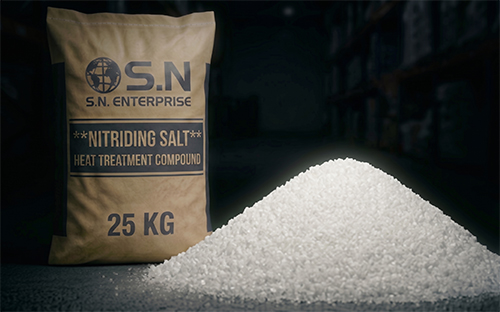
Salt bath nitrocarburising to diffuse nitrogen and carbon into steel surfaces — improving wear resistance, anti-seizure and scuffing resistance without distortion.
Nitriding Salt is a cyanate-based salt bath compound for the liquid nitrocarburising (salt bath nitriding) process. At 560°C–570°C, the molten salt diffuses nitrogen and a small amount of carbon into the steel surface — forming a hard compound layer that dramatically improves wear resistance, anti-seizure properties and scuffing resistance.
The process uses two salts together: the base nitriding salt and a regenerator salt (Hard Temp CN2). The regenerator replenishes the CNO content consumed during treatment, keeping the bath within specification. Because the process temperature is well below the steel's transformation range, components experience minimal distortion — a critical advantage over higher-temperature surface treatments.
| Salt Type | Cyanate-base liquid nitriding salt |
| Process | Nitrocarburising (Salt Bath Nitriding) |
| Working Temperature | 560°C – 570°C (±5°C) |
| Initial Melt Temperature | 580°C |
| CNO Content (Bath) | 31 – 40% |
| CO₃ Content (Bath) | 17 – 21% |
| CN Content (Bath) | 1.0% maximum |
| Preheat Required | Below 400°C for 15–30 min |
| Dip Time | 90–130 min (varies by section size) |
| Case Depth | 10–15 µm standard; up to 20 µm achievable |
| Packaging | 25 kg HDPE sealed bags |
| Bath Maintenance | Use regenerator salt (Hard Temp CN2, 2–5%) |
| Documentation | COA, MSDS, TDS included with every order |
How It Works
The cyanate level drives nitrogen diffusion. Regular testing keeps this within range for consistent case depth.
Carbonate content builds as the bath ages. Maintained within range by periodic desludging and regenerator addition.
Cyanide is kept below 1% for process control and regulatory compliance. Aeration helps maintain this limit.
Fill a clean, dry pot to half volume with nitriding salt. Start the furnace at 580°C. After melting, top up to working level and reset to 565°C ± 5°C. Install the desludging tray and aerator.
Start continuous aeration through a flow-control manometer. Air must be clean and oil-free. Aeration is maintained at all times — even when the bath is idle between production runs.
Add 10 g of Potassium Sulphide (K₂S) per 100 kg of salt used. Continue aging with aeration for 24 hours. Check bath parameters, adjust with regenerator salt if required, and desludge.
Preheat components below 400°C for 15–30 minutes. Dip in the salt bath for 90–130 minutes. After dipping, drain molten salt over the pot and quench in water. Wash in clean overflowing water and dry.
Replenish with fresh nitriding salt to make up drag-out loss. Add regenerator salt at 2–5% of nitriding salt weight. During normal operation add 2–3 g of K₂S per 100 kg salt per day.
Desludge twice a week or as required. Stop aeration, allow bath to settle for 20 minutes, then remove the sludge tray. Resume aeration immediately after.
Why Use Salt Bath Nitriding
The compound layer formed by nitrogen and carbon diffusion is significantly harder than the base metal — extending service life of moving components.
Nitrided surfaces resist metal-to-metal seizure under boundary lubrication conditions — critical for gears, cams and sliding components.
Processing below the steel's transformation temperature means components stay in the ferritic phase. Dimensional changes are negligible compared to conventional quench-and-temper.
Liquid nitriding at 560°C–570°C achieves the required case depth in 90–130 minutes. Gas nitriding for equivalent case depths takes 20–80 hours.
Components emerge with a dark, compact surface layer ready for use or light polishing. No scale, decarburisation or oxidation.
Low processing temperature allows nitriding of fully machined and dimensionally finished components without requiring grinding after treatment.
Where It's Used
Crankshafts, camshafts, rocker arms and gear components where wear resistance and anti-seizure behaviour determine service life.
Hot forging dies and die-casting tool steels treated to resist heat checking, erosion and metal-to-metal seizure under high-pressure contact.
Plastics and rubber extruder screws treated to resist abrasive wear from filled polymers — extending intervals between reconditioning.
Transmission gears, shift forks and splined shafts in industrial gearboxes requiring a hard, lubricious surface on a tough core.
Finished parts in alloy steels that need surface hardening without the distortion risk of quench-and-temper — such as jig and fixture components.
Commercial heat treatment facilities processing mixed orders of automotive, engineering and tooling components on a single liquid nitriding line.
Safe Handling
Nitriding salt baths operate at high temperature and contain cyanate compounds. All standard molten salt handling precautions apply. Effluents must be treated as per applicable environmental regulations before discharge.
Check surface hardness of treated components every day using a calibrated hardness tester.
Verify case depth by metallographic section once a week or as production requires.
Test CNO, CO₃ and CN content regularly using rust-free M.S. rod samples at working temperature.
Remove sludge tray at least twice weekly. Stop aeration 20 minutes before desludging to allow sludge to settle.
Complete Your Process
Barium-base carburising salt for liquid carburising of mild steel at 900°C–950°C.
View DetailsPre-heating bath at 660°C–900°C used before hardening and austenitising.
View DetailsAnti-decarburization additive to restore bath neutrality and protect surface carbon.
View DetailsShips from Shapar warehouse. COA, MSDS and TDS included. Same-day dispatch before 2 PM.