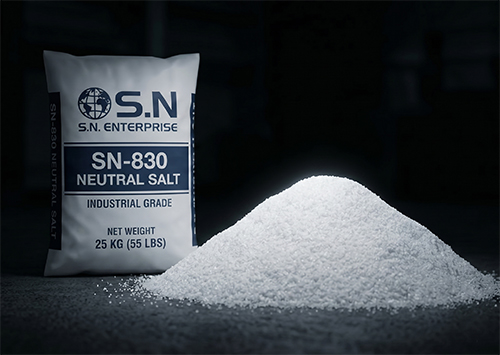
A high-density barium chloride-base neutral salt for hardening alloy tool steels — including high carbon, high chromium grades — across a wide working range of 800°C to 1100°C. Scale-free, decarburization-free surface every time.
SN-830 is a barium chloride-based neutral hardening salt formulated for the austenitising and hardening of alloy tool steels — particularly the high carbon, high chromium family of grades such as D2, D3, and their equivalents, as well as chromium-bearing stainless tool steels and hot-work die steels.
With a barium chloride content exceeding 60%, SN-830 delivers a high-density molten bath that transfers heat rapidly and uniformly to every section of the workpiece. At 825°C, bath density sits at 74–75 kg/cuft — a higher figure than chloride-only neutral salts — which means components heat through faster and more evenly, reducing both cycle time and the risk of distortion in precision tool steel parts.
Because the bath is chemically neutral at operating temperature, steel surfaces undergo no oxidation, no scaling, and no decarburization during the soak period. Parts emerge bright, scale-free, and dimensionally close to their pre-treatment state — ready for quench without surface rework.
| Product Code | SN-830 |
| Salt Type | Neutral hardening salt — barium chloride base |
| Base Composition | Barium Chloride > 60% |
| Working Temperature | 800°C – 1100°C |
| Density at 825°C | 74 – 75 kg/cuft (approx.) |
| Physical Form | White crystalline dry powder |
| Rectifier | Boron-base rectifier — 50 g per 300 kg salt per 8 hrs |
| Rectifier Frequency | Every 8 hours of operation |
| Packaging | 25 kg HDPE sealed bags |
| Storage | Cool, dry place — keep sealed, avoid moisture |
| Documentation | COA, MSDS, TDS included with every order |
Why SN-830
800°C to 1100°C in a single bath — covering the full austenitising range of high carbon, high chromium cold-work tool steels (D2, D3) and chromium hot-work grades in one setup.
At 74–75 kg/cuft at 825°C, the high-density barium chloride bath transfers heat to the workpiece faster and more uniformly than lower-density chloride salts — reducing soak times and minimising distortion.
Chemically neutral at all operating temperatures — steel surfaces emerge with their full surface carbon layer intact. No decarburized soft skin, no grinding allowance needed to recover hardness.
Parts come out of the bath bright and clean. No oxide scale, no discolouration. The neutral atmosphere of the molten salt completely excludes atmospheric oxygen from the workpiece surface.
The high-density bath provides excellent thermal conductivity and natural agitation — every section of a complex tool steel component reaches austenitising temperature evenly, avoiding thermal gradients that cause cracking.
Suitable for D2, D3 (12% Cr cold-work), H11, H13 (hot-work die steel), 420 and 440C stainless tool steels, and other high-alloy grades requiring a controlled, neutral atmosphere hardening bath.
Where It's Used
Primary application for D2 and D3 (2% C, 12% Cr) grades — hardening at 1020–1040°C in SN-830 bath gives a clean, distortion-controlled result suited to dies, punches and gauges.
H13 and H11 hot-work die steels austenitised at 1020–1050°C. The uniform heat transfer of the barium chloride bath is especially important for large-section die blocks.
Chromium rust-resisting steels and 440C-type stainless harden in the 1000–1070°C range — within the SN-830 working window — with excellent surface quality after quench.
Complex forming dies, blanking tools, and cutting inserts in high-alloy steel that require precise temperature control and a decarb-free environment during austenitising soak.
Large bearing rings and precision races in alloy steel grades requiring even temperature distribution to minimise ovality and runout after quench and temper.
A versatile single-bath solution for job shops handling a mixed load of alloy tool steel components across a wide temperature range in a single shift.
Bath Maintenance
Over time in operation, contaminants from the atmosphere and from workpiece surfaces accumulate in any neutral salt bath, shifting its chemistry and reducing its ability to protect steel from oxidation and decarburization. The boron-base Rectifier corrects this drift, consuming the oxidizing species and restoring the bath to a chemically neutral state after each working period.
Dose the Rectifier at the end of each 8-hour working period — or whenever the bath shows signs of discolouration or reduced clarity that indicate chemistry drift.
Add 50 g of boron-base Rectifier per 300 kg of SN-830 salt. Scale the dose proportionally to your pot size. Do not overdose — excess Rectifier is wasted and adds unnecessary contamination.
After adding the Rectifier, allow it to fully dissolve and mix into the bath before loading the next batch of components. A few minutes at operating temperature is sufficient.
A correctly maintained SN-830 bath should appear clear when viewed from above. Persistent cloudiness or a thick slag layer indicates either overloading of contamination or insufficient Rectifier dosing.
| Parameter | Specification |
|---|---|
| Rectifier type | Boron base |
| Dosage | 50 g / 300 kg salt |
| Frequency | Every 8 hours |
| When to overdose | Never — dose precisely |
| Steel Grade | Temp Range |
|---|---|
| D2 / D3 (12% Cr) | 1020 – 1040°C |
| H11 / H13 (Hot Work) | 1020 – 1050°C |
| 420 / 440C Stainless | 1000 – 1070°C |
| Pre-heat (all grades) | 800 – 870°C |
All temperatures are within the SN-830 working range of 800°C–1100°C. Confirm exact austenitising temperature against your steel supplier's data sheet.
Complete Your Process
Lower-temperature neutral salt — use as pre-heat before transferring to SN-830 bath.
View DetailsHigh-temperature hardening salt for HSS and hot-work steels above 970°C.
View DetailsTempering and martempering salt used after hardening in the SN-830 bath.
View DetailsShips from Shapar warehouse. COA, MSDS and TDS included. Same-day dispatch before 2 PM.